12 January 2016

Some rules for buying house and car


Some thumb rules for house and car as written by IFA based in Chennai: Mr. D. Muthukrishnan of Wise Wealth Advisers, A MUST READ. 
1) In a fair market, the rental yields are close to cost of borrowing. If cost of borrowing is 10%, rental yield also need to be around 10%. Then only it makes sense to own a house.
2) Another thumb rule is that the value of the property should not be more than 3 times one’s annual income. If your annual income is Rs.24 lakhs, your house purchase value should not be more than Rs.72 lakhs.
3) The house price to rent ratio should be around 15. If a house cost Rs.1 Crore and the annual rent is Rs.3 lakhs; the price to rent ratio works out to 33, which is very expensive. Going by the thumb rule, if this ratio is above 20, then the cost of owning is considered higher than cost of renting. This means you would be better of paying rent. In other words, the minimum rental yield should be 5% to justify owning a property.
4) Make it a point to save atleast 50% of the property value as down payment; till then live in a rented place. 10% down payment means you work rest of the life for welfare of the bank.
5) Home loan EMI as a part of your income (debt to income ratio) should not exceed 30% (i.e.) EMI should not exceed 30% of your take home pay.
6) The maximum you can pay for the car should not be more than 5% of your net worth. So if your net worth is Rs.2 crores, the car should not cost more than Rs.10 lakhs.
7) Makes more sense to buy a new car. But you should drive it for not less than 10 years.
8) 20/4/10 rule: If you decide to borrow for your car, you should at least put 20% down payment. The repayment tenure needs to be not more than 4 years. The monthly transportation cost should not be more than 10% of your take home salary. Transportation cost includes EMI, fuel and insurance.
9) The best rule: If you can save money and then buy a house and car by making full payment. No debt is the best option. Debt is slavery.

27 August 2015

Mutual Fund investing: A note for beginners


Read a good post here and and sharing some of the thoughts therein for new investors in mutual funds

The contents of this post are subject to the following assumptions:
  • The investment would be used for financial independence later in life and that there is no other goal in the horizon.
  • Basic fortifications like emergency fund, life insurance (if there are dependents), health insurance (for parents and self) are in place.
  • The young earner understands the importance of equity exposure
There are several articles on what a mutual fund is, different types of mutual funds, how to invest in direct mutual funds etc. So I choose not to reinvent the wheel here.

Direct Equity vs. Equity Mutual Funds

Personally I think there is absolutely no need for an individual ( young or old) to invest in direct equity. Equity mutual funds if held onto for a long enough period of time, is  more than likely to beat inflation and even give you a little extra after expenses.
Perhaps one can hasten financial independence with direct equity exposure but such a path is fraught with peril.
That said, in my uninformed opinion,  gradually accumulating and holding solid large cap companies instead of chasing multi-baggers is a decent way to ‘create wealth’. 
Naturally one must learn how to choose a solid business before taking the plunge. Since this would take a while, I suggest the following:
1) Start a SIP in a single large and mid-cap fund 
2) If you need to save tax, use an ELSS fund - tax saving mutual fund.  Just use ELSS + EPF + Term insurance premium (if applicable) for tax savings.
Personally I dont do SIP in ELSS funds (because getting rid of a poor performer would seem like forever). If you are okay with it, go for it. Just be sure to discontinue the SIP (and switch to another fund) after your EPF exceeds the 80C limit.
3) If you don’t care for direct equity, then that is all that you need to do!
  • As and when you get extra cash, buy more units Either in the ELSS fund (if you have not exhausted 80C limits) or in the large and mid-cap fund.
  • Do not monitor the value of your investment every day! Monitor only how much you invest 
4) If you wish to get into direct equity, then obviously you must learn. There are many useful resources. I prefer:
tyroinvestor.com and stableinvestor.com  and the resources mentioned in them.
These are written by passionate youngsters who are learning on the fly and do not hold anything back. I would prefer to learn from them any day compared to an ‘expert’ who runs a business.
We have a lifetime to learn and invest in equities. So there is no flaming hurry. Get the mutual fund investment going, learn in leisure and invest when you feel comfortable and ready.

DIY vs. Professional Help
While a young earner is best suited for DIY (do it yourself), taking professional help and then learning in one owns pace is also a fantastic idea.
Young earners are often under a lot of stress. So professional help could help calm nerves and enable them to focus on their career better.
I would recommend starting a relationship with a fee-only planner.
The learning cannot be skipped!

Regular plans vs. Direct plans

If you employ the services of an IFA or use online distribution portals, think of the trail commission that you can save in direct plans as a fee for service or value adds.
If the features of an online portal are effectively used, then there is no need to lose sleep over being in regular plans.
DIY investing need not be 100% DIY.  Someone who uses an intermediary for investments but handles other aspects of goal-based investing on their own (monitoring, tracking investments, rebalancing  etc.) are also DIY investors.

Yes, I am an investor in direct plans and promote them every time I get an excuse. 
More than time, effort etc. direct plan investing requires confidence. If you think you can confidently pick funds and manage your folio, go direct.
Else
1) either seek counsel from a fee-only planner and go direct or
2) go regular and be happy with your choice.
At the cost of repeating myself, either way the learning cannot be skipped!
Trust the planner or IFA. Do not post their recommendations in forums for ‘double-checking’. 
Finally,
  • Never ever buy mutual funds from a bank.
  • Do not buy an NFO because  it is an NFO.
  • Do not buy/sell a fund because others are talking highly/lowly about it.
  • Do not clutter your portfolio. Choose a minimalist portfolio.
To sum it up, choose ONE fund, invest with discipline. Do not look the folio value for at least 5 years. In the meanwhile learn about stock investing, if you must. Seek professional advice and not free lunch if you lack confidence.

6 August 2015

The 10 commandments of investing

"The 10 commandments of investing" written by Prof. Parag Rijwani Thought it would be of interest to those who have not seen it before (he posted it a few months backin a FB Post)
-------------------------------------------
This is what I wrote to a past student sometime back. He has recently started his career and is posted abroad on company’s projects. The 10 commandments!

1. Create an emergency fund that can meet your expenses if you remain unemployed for 5-6 months. Part of this should be kept in savings bank account and remaining in an e-fixed deposit that is done through net banking. These can be withdrawn anytime without any charges /penalties. 

2. Take a TERM INSURANCE for yourself as soon as you have a financial liability to meet. Comprehend that if you don’t have financial liability, YOU don’t need insurance. NEVER buy any other life insurance product because one should not mix two spirits. Cheers!

3. Increase the Term Insurance cover by taking newer/additional policies as and when you financial liabilities/future goals emerge. Like after getting married, having kid(s), parents getting retired, borrowing loan(s) etc. Always buy it online by disclosing ALL details CORRECTLY. Hiding anything may defeat the purpose resulting into claim rejection i.e. if you enjoy Chivas Regal, disclose it!

4. Take a medical insurance immediately! (even if you have a cover from your employer). Take a family floater that covers your present and future dependents (if any). Search for a product called Max Bupa. Read more on this before buying. 

5. Equity (read again, ONLY equity) can give you inflation beating returns (real returns) in long run. So stay invested in equity till the time you need money in your life. Invest in direct equity (i.e. stocks) ONLY if you have time and skill to spot next Wipro, HDFC etc. I know a few who read 50 annual reports and invest in 4-5. If you can’t do this and/or can’t spare time, share 2-3% with Mutual Fund manager. 2-3 mutual fund schemes are sufficient to make a GOOD portfolio. The more NOT the merrier!

6. Debt is a very crucial part of your portfolio. Instruments like PF, PPF, Bonds, FDs etc. are few to list. Most of them are tax inefficient and illiquid. I am lucky to have a decent contribution to PF so I have conveniently and completely PPF. Find out what suits you. 

7. Do NOT buy Real Estate and Gold beyond your consumption needs i.e. they do not find a place in you ‘investment’ portfolio. If my father had not bought the present house that I reside in, I had stayed in rented house ALL my life. 

8. Use of credit card should be prudent. I use credit card for virtually EVERY expense that I incur. But in the past decade I have NEVER defaulted on paying the full bill before the due date. CIBIL score (google it if you hear this for the first time). 

9. Learn to live a frugal lifestyle and simple eating habits. Do not overboard on lavishing habits. Do NOT buy things that you really don’t need. Invest in your health. Invest at least 40% of your take home salary every month. Investing is like a habit, cultivate it!

10. Spare time to learn personal finances. No agent can make YOU rich. You must take charge of your finances ASAP. Read about personal financial planning (books, blogs, articles but don’t get carried away) and talk about it with people who can add to your knowledge. There is EQUAL amount of financial PORN out there!

Abhi ke liye itna kaafi hai, shayad!

5 August 2015

Five general rules for investing money wisely


At its core, investing money wisely comes down to a handful of behaviors that harness several powerful forces to build wealth for your family.  You "win" the game, so to speak, when your passive income reaches a point where it, by itself, gives you financial independence.  This means that the finish line for every investor is different because everyone has different lifestyle goals, objectives, and plans.

I have five general rules for investing money wisely - things that, if followed, can make the journey to fiscal affluence a lot easier.  Keep them in mind when thinking about how to handle your own financial concerns, taking what works for you.
 Some people truly want nothing more than a few acres in view of a mountain, a log cabin, a hunting rifle, a faithful dog, and a good book to read on the porch.  Others want fast cars, Ocean-side villas, expensive watches, and trust funds stuffed with so many stocksbondsmutual funds, and real estate properties, their great-grandchildren won't have to worry about anything.

1. Investing Money Wisely Means Never Owning Something You Don't Understand

If there is one rule that could save tremendous amounts of financial heartache it would be this: Do not buy or hold anything you can't explain to a kindergartener in three sentences or less: How it makes its money, what its potential pitfalls are, and how that money finds its way into your hands.  This sounds so simple - and it is - but few people seem to follow it.
 The moment a bull market starts raging somewhere, otherwise perfectly reasonable people who have enough common sense not to walk out into the rain without an umbrella suddenly get it in their heads they should be buying collateralized debt obligations, even though they couldn't tell you what they are, or giving up their safe cash deposits and swapping them for auction rate securities, even though they can't explain how they work.
Do you know the difference between a share of stock and a master limited partnership unit?  No?  Then don't buy MLPs through your broker.  They look like stocks, trade like stocks, but are most definitely not stocks.  You can be in for an unpleasant tax surprise if you start collecting them without knowing what you're doing.  Do you know how preferred stock differs from common stock and corporate bonds?  No?  Then don't buy them.  The same goes for everything from convertible shares to REITs.  There's plenty of time to learn about these securities and you can always buy them tomorrow.  Jumping in before you are ready, well-informed, and aware of the dangers is like a non-swimmer deciding his first foray into the pool should be from the the high dive board of an Olympic facility.  It's probably not going to end well and if it does, it's luck, not skill.

2. Investing Money Wisely Means Protecting Yourself Against the Downside By Proactively Managing Risk

Risk is ever-present when managing your money and investing wisely requires you to respect it while simultaneously reducing it.  If you don't, you can wipe out years, maybe even decades or a lifetime, of savings; savings for which you swapped part of your life expectancy (quite literally - you sold hours of your life in exchange for that cash; hours you could have been sitting on a beach, writing a novel, learning to paint, sailing off the coast of Florida, or pursuing your favorite hobby).  There are the three types of investment risk, there's liquidity risk, there's inflation risk, there's market risk, counter-party risk, fraud risk.  On and on it goes.  This is one of the reasons it is so important to focus not on absolute returns, but on risk-adjusted returns; to actively, constantly, strive to reduce risk.
For most investors, dollar cost averaging into a diversified portfolio over many decades is, statistically, the most successful way to drastically reduce risks of all kind.  Couple this with large cash reserves to provide a cushion in the event of a job loss, recession, stock market closure or collapse, natural disaster, or other non-expected situations and you are on the right track.  This might sound counter-intuitive but rich investors are actually obsessed with maintaining high cash balances.  Of the 115,610,216 households in the United States, an estimated 1,821,745 have investment portfolios worth more than $3,000,000 and much of this money is parked in liquid greenbacks.  How do you think the wealthy are able to buy up assets on the cheap when everything goes south?  Perhaps nobody embodies this concept better than billionaire investor Warren Buffett.  His holding companyBerkshire Hathaway, has an estimated $60 billion in cash and cash equivalents sitting on the balance sheet.  He piles up money, sometimes for years on end - there was a period spanning much of the 1980's, in fact, when he didn't buy a single stock at all - waiting for the right opportunity to pick up incredible enterprises that he then sits on for decades.

3. Investing Money Wisely Means Taking Advantage of the Power of Compound Interest as Early as Possible

Wise investing means harnessing the power of compound interest.  The younger you start, the easier it is to amass a jaw-dropping net worth.  A college student saving a mere $111 per paycheck, by way of example, could end up with $4,426,000.  This is one of the reasons it's so easy for the rich to get richer: When you set up a trust fund for your children or grandchildren, they get to benefit from a lifetime of compounding, watching their money grow while in elementary school.  Those extra years are extraordinary in terms of final outcomes.
Perhaps an actual mathematical example might help.  We'll use some time value of money formulas.  Imagine there are three people - Samuel, Abigail, and Daisy.
  • Samuel begins life with no investments, doesn't save throughout his twenties and thirties, but starts making a lot of money by the time he is 45 at which point he promptly begins putting aside $5,000 a month.  Assuming average rates of return on his equities, he ends up with $3,436,500 before taxes by the time he retires.
  • Abigail begins life with no investments but she was always keen on personal finance and money.  At 18 years old, she decides to put aside $100 a week.  She maintains this habit throughout her lifetime and never increased the amount by inflation, meaning it progressively became easier and easier to fund.  Assuming average rates of return on her equities, she ends up with $4,534,269 before taxes by the time she retires.
  • Daisy is born and from the first breath she takes, her parents put aside $25 a week for her investments.  This routine is maintained throughout her entire life, and it is never increased with inflation.  Assuming average rates of return on her equities, she ends up with $6,361,819 by the time she retires.
If you want to know how to get rich, there's the secret: Either put a lot of money to work, let it work for a long period of time, or, ideally, both.

4. Investing Money Wisely Means Arranging Your Holdings and Behaving In a Way That Allows You To Minimize Taxes

Having seen how powerful compounding is in the last section, you realize that every dollar is worth a whole lot more future dollars if prudently managed.  The more you can save on taxes, the more money you have working for you.  Learn how to take advantage of deferred tax liabilities.  Figure out how to use a Roth IRA, which is the closest thing to a perfect tax shelter the poor and middle classes are likely to ever get.  Have your family structure its holdings so the stepped-up basis loophole can be taken advantage of upon death.  Utilize the asset placement technique to minimize tax payments.  Form family limited partnerships to transfer wealth using liquidity discounts to lower gift taxes.
Do not cheat on your taxes, do not get close to the edge of the lines, but definitely take advantage of all of the breaks Congress has given you under the law. Your elected representatives put them there for a reason and assumed you'd avail yourself of them so speak with your advisors to find out what you're missing.

5. Investing Money Wisely Means Controlling Your Expenses

Sometimes, fees can be worth it.  For certain high net worth individuals, especially with complex needs (say you worked for a Fortune 500 company and ended up accumulating a concentrated block of highly appreciated stock you need to liquidate in an orderly manner, while minimizing taxes and protecting against a sudden market collapse), a private bank or registered investment advisor charging a 1% or 2% fee can absolutely be worth his or her weight in gold, far exceeding the amount that would have been saved with the attempted do-it-yourself approach.  Structuring a portfolio using something like a charitable remainder trust alone can pay for itself in tax savings many, many times over.  Setting up a so-called QTIP trust that makes sure children from a first marriage aren't purposely or accidentally disinherited by a second (or fourth) spouse while the latter spouse is still provided for during the remainder of his or her life has value.  There are dozens of situations in which that fee about which everyone likes to complain is the best money you can spend, provided it is integrated into a broader service package.  Real estate developer?  You might get access to much better financing terms on your projects by being part of the private client group, the fee you pay on your trust and portfolio assets dwarfed by the interest savings on the debt side.  Your teenage son got in an accident, you're out of the country, and you need someone to bail him out of jail in the middle of the night?  Your white-shoe private wealth management firm might do it for you but a firm like Vanguard certainly wont.  That's the trade-off.  You have to look at the whole picture.  What are you getting?  Market returns aren't the only variable.  Service, risk reduction, access, expanded product offerings, and privacy assistance are all on the menu.
That said, for many small and medium-sized investors, this isn't a concern.  They are never going to have enough wealth, nor needs complex enough, to care about the added services and benefits.  There are no oil paintings to insure or background checks on nannies to perform.  In that sense, costs matter and the costs to which you want to pay the most attention probably include the mutual fund expense ratio.  For many, this means opting for something like a low-cost, passively managed index fund from a firm like the aforementioned Vanguard.  For others, it's going to be switching to a discount brokerage firm charging $10 or less per trade instead of a traditional bank that assesses a $150 commission on the same trade execution.

6 July 2015

A discussion on whether a Direct MF investor should check scheme portfolios

Was send a link to an online discussion which was interesting

Question Asked:
Many DIY investors just see performance of the last 1,2,7,10 years and the star ratings and invest.
So they do not see the portfolios. Even IFAs do not know portfolios. I want to know – Do you need to see portfolios esp. of large and multi cap schemes or just follow the ratings and performance.
For mid caps – what is your opinion. Many just see performance and ratings. That may not be good??

Some say that one must check since holding in your portfolio will overlap if u dont see. That’s why I asked, for benefit of us who only DIY. Great place to start good discussion and will help us see how others do their investments

Answers: 
1. You mean what stocks the funds hold?  I don’t. If I knew how to analyze that, I would be a direct stock investor. Overlap is important. You don’t need to check that if you only use funds with a narrow mandate. Like one blue chip fund and one mid/small cap fund

2. If you see all large cap funds have invested in more are less same companies but the return is not always same, I think it’s mainly due to fund manager ability to manage the fund well and get best return so probably just one fund in each category may be bit restricting yourself.


3. I am currently invested only in one fund, and am predominantly into direct stocks. When i wanted to finalize this fund, i did check portfolios of the funds i had shortlisted (VR/Moneycontrol/Morningstar provide these snapshots). Surprisingly, what i found was that a lot of mid cap/value funds also had large caps; probably to act as a cushion. There were many which had exposure to dominant stocks in the index itself – again probably as a way to protect downside in case of a drop in mid cap stocks.
4. I think this is a good way to shortlist a fund, along with metrics like churn rate, returns % etc. While this helps in finding out actual portfolio overlaps as suggested above by Pattu, this also gives a hint whether the fund manager is backing duds ( say for example – is the fund invested in a Sahara Group or equivalent); and could help investors take a more informed call.

5. There are some practical difficulties in studying the portfolio of mutual fund scheme. They are
1. We always get information about their holding at the end of month, which IMO is very late
2. We do not know either the rationale behind buying those stocks. Nor do we know either their purchase price, time of purchase or holding period or exit price. Again we do not know whether the exit is partial or full and at what price and for what reasons.
3. The very purpose of approaching the stock market through MF is to a. Compensate our ignorance or lack of time or both with regard to stock investing
b. To get reasonable returns (I mean superior returns) for the fees and commissions we pay to MF and also for taking the risk of investing in stocks.
c. If we know how to do the aforesaid things, we can do it by ourselves and save the fees and commission paid to MFs
4. Portfolio overlap? You can hardly avoid that. All large cap funds have almost the same stocks albeit in slightly different proportion. It is mid and small cap funds whose portfolios vary by vast extent. But they move up and down too much and too fast. By the time you get the information about them, it is too late.
So my suggestion is stop worrying too much about fund portfolios and stick with the funds that you are comfortable with.
Hope this helps

6. I strongly believe that you should check the portfolio of the MFs you are investing in! A few reasons being, you are entrusting your money to the fund manager, don’t you want to know what’s being done with it? (Imagine you gave someone the money as a loan, would you not check?)
secondly, you want to ensure that the fund walks the talk. If it’s chasing glamour by taking high risk, then you will know from the portfolio.
finally, by knowing the portfolio you will start learning what decisions are going wrong and whether the fund manager is learning from them, acting quickly, etc. this helps you in increasing your confidence and remain invested when the market tanks (trust me, if you are a long term investor, you’ll see a few crashes.) if you don’t have complete faith in the fund manager, you’ll exit at the worst possible time…Disclaimer: I’m mostly a direct equity investor and ETF guy


28 June 2015

Building Your Own Low-Cost Equity-Indexed Annuity Or Structured Note


Given the market volatility of the past 15 years, with both the “tech wreck” and the financial crisis, a growing number of consumers are seeking more safety for their investment portfolios, through everything from more proactive risk management strategies, to using products like equity-indexed annuities and structured notes that explicitly provide for "some" upside participation in bull markets, but with downside protection in a bear market.
Yet the reality is that constructing downside protection and a principal guarantee over time doesn’t actually require products like equity-indexed annuities and structured notes. They can actually be constructed with relatively simple combinations of bonds and either stocks or equity index options. In fact, just buying a portfolio of bonds and using the interest to buy at-the-money call options is sufficient to produce a partial upside participation rate in equities with a downside guarantee!
Unfortunately, though, creating such pairings can be especially difficult in low interest rate environments, as there simply isn’t enough yield to afford very many options contracts, which in turn results in relatively low equity participation rates. Yet given that annuity companies and structured note providers are subject to the same constraints, in the end investors will likely suffer from low returns in such solutions, regardless of which vehicle is used… and in fact may have the greatest upside potential by simply constructing the strategies themselves, and avoiding the internal costs of such products in the first place!

Structured Note Alternatives - Building A 10-Year Downside Guarantee For Stocks Using Government Bonds
Imagine for a moment that you wanted to invest in equities for the next 10 years, but have a guarantee that there would be no downside risk; no matter what, you want to be assured that the portfolio will return at least your principal at the end of the decade.
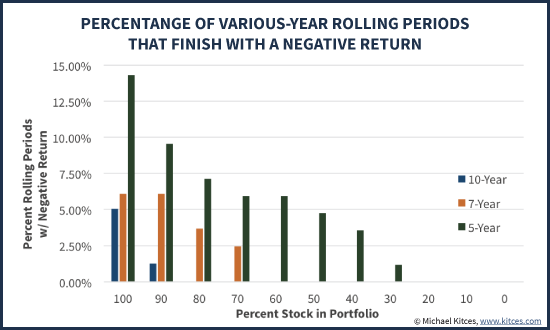
On the one hand, an investor could simply approach this by recognizing that the probability of having a (nominal) loss in equities over a decade is already a very low probability event, and one whose probability declines even further by diversifying into bonds. The chart below shows the probability of having a cumulative total return that is negative after rolling 5-, 7-, and 10-year periods, for portfolios varying from 100% in stocks in 100% in (intermediate term government) bonds.
Probability of Finishing With A Negative Return Over Rolling 5, 7, and 10-Year Portfolios At Varying Equity Exposures
Not surprisingly, while the odds of a negative return are fairly low across the board, and the odds decline further as the time horizon lengthens and the portfolio becomes more conservative. While many portfolios may still be negative after 5 years, historically over a 7-year time period, a portfolio with 60%-or-less in stocks has never had a negative cumulative return. Over a 10-year time horizon, as long as bond exposure is at least 20% (i.e., equity exposure is down to 80%), a negative cumulative return has never occurred over such a "long" time horizon; in other words, to the extent that equities were down at all, with as little as 20% in bonds the bond return was enough to fully offset any losses. 
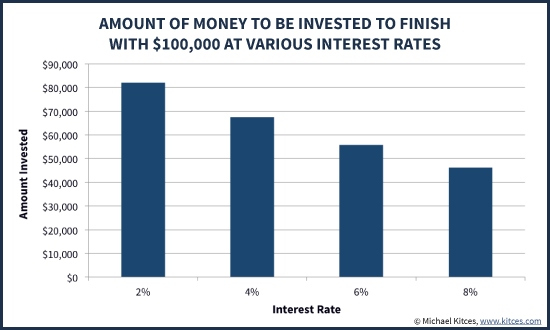
Of course, while equities have historically always recovered enough that 20% in bonds is "enough" over a 10-year time horizon, in the extreme an investor could actually guarantee that the portfolio will never have a negative return, simply by buying enough 10-year government bonds to ensure that just holding until maturity alone will replenish the entire principal. In such a scenario, even if the stock market in the aggregate went to zero, the bonds alone would still mature with sufficient value to replenish the original principal. Of course, the amount it takes in bonds to provide for that principal replacement depends on the (10-year) bond yield in the first place; the higher the yield, the less it takes in bonds to replace the principal down the road (and the more than can be invested into equities), while in today’s environment with lower yields, it takes far more, as shown in the chart below. (Chart assumes the investor simply buys 10-year zero-coupon Treasury STRIPS at the specified rate.)
Required Principal In Bonds To Recover Back To $100,000 Assuming Various Interest Rate Yields
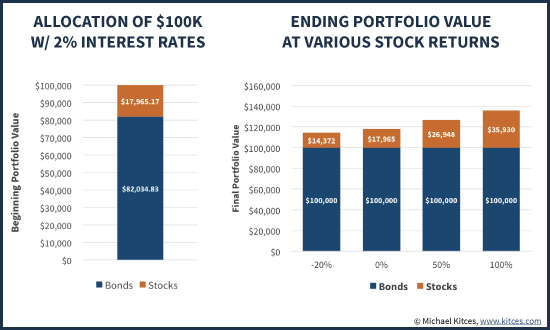
Once Treasuries are in place to secure the “floor”, the investor would simply put the rest of his/her funds into equities… at a 2% interest rate, this would require about 82% of the portfolio in bonds, and the remaining 18% in equities. As noted earlier, in this scenario the stocks could go all the way to zero, and the investor would still be protected because the bonds alone would mature at par to replace the original ($100,000) portfolio value.
In fact, even if equities were merely flat for the decade, the investor would still end out with 100% of the original principal (from bonds), plus 100% of the original investment in equities, resulting in a final value up 18% cumulatively, for a modest positive total return of about 1.67%/year. Even if equities are down 20%, there will still be a positive return for the total portfolio of about 1.35%/year! And of course if equities are up, the investor just makes even more on top of the bond return. Either way, the principal guarantee stays intact no matter what.
Ending Portfolio Values With Bond Principal Guarantee Plus Equity Upside Participation


Of course, because a large portion of the funds were occupied by the bond allocation – especially given today’s low interest rates – the investor only gets a “modest” participation in the total upside of equities. Even in the scenario where the market grows by 100% cumulatively in a decade (an average annual growth rate of about 7% for the stocks), the overall portfolio is only up at a 3.1% average annual compound growth rate. In other words, the investor only participated in about 44% of the total upside in this bull market scenario. But then again, the investor got that upside participation with no downside risk at all, as principal itself was entirely secured by just the bonds alone. Given current Treasury yields, any investor could theoretically do this today.
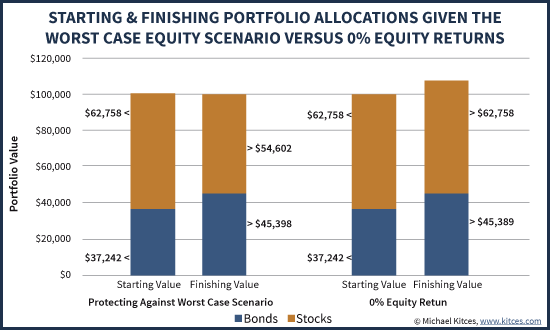
Notably, one of the caveats to the strategy of pairing Treasuries-to-replace-principal with a stock allocation is that even if stocks finish flat, the portfolio will technically be up. In order to achieve a scenario where the total return is zero when stocks are flat, the investor could choose to allocate less to bonds and more to stocks - for instance, putting in enough that even if stocks do have their worst decade ever, the remaining value in equities - plus the value of the bonds - would be enough to replace/secure the original $100,000 portfolio value. And if the equities "merely" finished flat (at a 0% return), the portfolio again would be up at least a little.
Pairing Equities And Bonds To Create Portfolio Protection
Pairing Treasury Bonds With Equity Index Options For A More Efficient Downside Guarantee

Given the challenges of cleanly aligning a guaranteed floor and equity upside by pairing together stocks and bonds directly, an alternative way to structure the transaction is to use bonds and equity index options, as the latter provide for a more effective “alignment” of upside and floor guarantee.
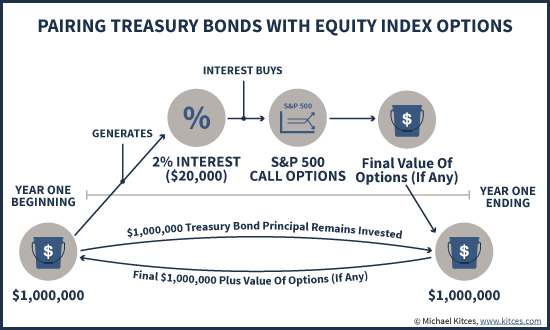
For instance, in the simplest scenario, an investor might simply buy a series of 10-year Treasury bonds, and use the annual bond interest to buy a series of 1-year at-the-money call options for the desired equity index (e.g., the S&P 500). At worst, if the market doesn’t go up for 10 years, the options will expire worthless every year, but the bonds remain to mature at par at the end of the decade, returning the target principal amount. And any year the options expire inthe money, the investor participates in (at least some of) the upside.
Pairing Treasury Bonds With Equity Index Options
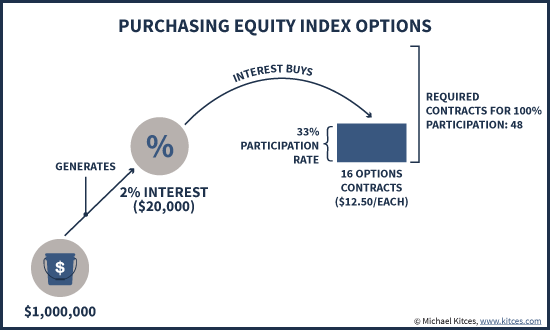
Of course, at today’s low interest rates, there’s not a lot of interest available to invest into those options. With the 10-year Treasury yielding roughly 2%, and an at-the-money call option on SPY available for $12.50 for a strike price of $210 (as of when the S&P 500 was at 2,100), an investor with a $1,000,000 portfolio could buy roughly 16 options contracts (with the 2% x $1,000,000 principal = $20,000/year of interest). Of course, it would actually take about 48 call options at a strike price of $210 to get full equity participation on a $1,000,000 account, so buying “just” 16 options contracts would give the investor an upside equity participation rate of roughly 33%.
Purchasing Equity Index Options With Bond Interest For A 33% Participation Rate
In other words, given what today’s interest rates will bear out in buying call options, the investor effectively gets a 33% participation in the upside price movement of the S&P 500 (note: price changes only, as options don’t pay dividends!), with “no downside”, since at worst the options merely expire worthless at the end of the year and the investor buys new options again next year while bond principal remains intact (to mature at par at the end).
Since options would be purchased one year at a time in this example, each year the starting point for equity participation will “reset” to the then-current level of the index, and the participation rate itself will fluctuate up and down with then-current pricing of options (which may be more or less expensive, depending on changes in volatility along the way).
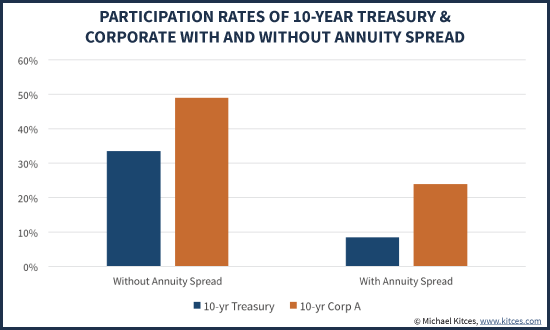
Of course, to the extent that the investor is comfortable taking a little more risk, the participation rate can be improved further. For instance, with 10-year A-rated corporate bonds (slightly greater risk of default than Treasuries) yielding approximately 2.9%, using that interest buys enough options contracts to produce a first-year participation rate of 49% instead of “just” 33%.
On the other hand, the caveat is that in the context of an equity-indexed annuity (or a structured note that functions in a similar manner), participation rates will be lower, as the insurance company needs an opportunity to make money as well, as a for-profit entity (not to mention recovering its costs of overhead and distribution). With an equity-indexed annuity, this is accomplished through an interest rate spread – in other words, while the insurance company might invest in bonds that pay 2%, it may keep 1.5% of that interest yield to cover everything from overhead to profit margins to the commissions paid to the selling agent, with only the remaining 0.5% yield going into options. Given today’s low interest rates, though, cutting out a 1.5% interest rate spread has a dramatic impact, reducing the participation rate to only 8% using 10-year Treasuries and 24% with a 10-year A-rated corporate bond.
Equity Upside Participation Rates With Treasury Or Corporate Bonds With And Without Annuity Company Earning Interest Rate Spread
Because the participation rate is driven by the number of options contracts purchased, and the free cash flow to purchase those options is derived from bond interest, the overall level of interest rates turns out to be a key factor in the potential participation rate of an equity-upside-with-downside-protection strategy. If/when/as interest rates rise, so too will available participation rates, either for equity-indexed annuities, structured notes, or for investors and advisors who wish to construct their own using bonds and options.
On the other hand, as long as interest rates stay low, both insurance companies and investors may feel forced to find other means to boost participation rates, either through strategies to increase the yield and available dollars to buy options, or to manage the (net) cost of options.
For instance, an investor might own different (e.g., lesser quality) bonds to stretch for greater yield, or move into other segments of the bond market that might otherwise generate better cash flows. The more the bond cash flows, the more money there is to buy options, and the greater the upside participation rate. In the context of equity-indexed annuities, insurance companies often use their size and scale to negotiate for better pricing on bond deals to maximize their yield. Investors can also boost their participation rates by giving up a bit on their guarantees in the first place; for instance, if guaranteeing “just” 90% of the principal is sufficient, the investor can put less money in bonds, which frees up more capital to invest over time towards options instead, resulting in more equity upside participation.
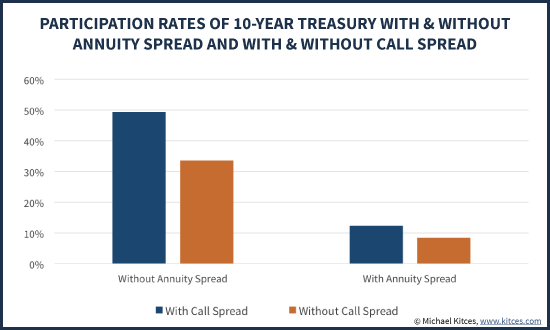
Alternatively, the net cost of options can also be reduced with call spreads, like buying an at-the-money option but selling an out-of-the-money call option at a higher strike price. The net result puts an effective cap on the maximum appreciation, but increases the participation rate along with it. For instance, a call option for SPY at a strike price of 230 costs approximately $4.00 (at the time of this writing when the S&P 500 is around 2,100), which would reduce the net cost of an at-the-money call option from $12.50 to only $8.50. In turn, this would allow a larger number of options to be purchased, but the maximum appreciation for the year would be limited to only about 9.5% (the gain from 210 to 230 on the SPY, corresponding to 2,100 to 2,300 on the S&P 500). Of course, when purchased from an equity-indexed annuity company (or a structured note) that must charge an annuity interest rate spread, participation rates will still be compressed slightly.
Equity Upside Participation Rates Using Treasury Bonds With Either Unlimited Upside Participation Or A 9.5% Equity Cap
Amplifying Participation Rates In A Low Yield World With Call Spread Caps And Monthly Averaging

Notably, in the context of equity-indexed annuities in particular, insurance companies have also sought to increase participation rates by shifting from annual point-to-point strategies (i.e., participation in the one-year price return of an index like the S&P 500) to “monthly averaging” strategies instead. With monthly averaging, the investor’s return is calculated by taking theaverage price of the index throughout the year, comparing it to the original, and calculating the appreciation accordingly. Thus, for instance, if the market went up 12% for the year by rising 1% each month, the S&P 500 would grow from 2,100 to approximately 2,350, and the averageprice for the year would be about 2,225. Since 2,225 is a 6% increase over the starting level of 2,100, the monthly averaging formula would return 6%, then further adjusted by the participation rate (so if the participation rate was 75%, the final return would be 6% x 75% = 4.5%, even though the market was up 12% overall).
Ultimately, monthly averaging formulas will (on average) produce lower returns in bull markets than point-to-point structures since markets average positive returns (e.g., a normal point-to-point one-year option in this example would have applied the participation rate to 12% upside instead of only 6%). However, because the monthly averaging options contracts are generally cheaper (for this same reason about their expected returns), annuities based on them will tend to have higher participation rates; in the end, given the different combinations of upside potential and participation rates in that upside, investors may not actually see substantively different returns either way (e.g., 75% participation on 6% appreciation in a monthly average formula is similar to getting 40% participation on the 12% upside in a point-to-point formula). In many cases, which is better will simply depend on the exact path the market takes for the year - at least, if all else is held equal (though that is not always the case).
While monthly averaging options in particular generally aren’t available to consumers (as they’re privately negotiated derivatives for insurance companies that aren’t traded on public exchanges for consumers to purchase), the remaining strategies of investing for greater bond yields, accepting diminished principal guarantees in exchange for more upside, and using call option spreads to get greater participation but with an upside cap, are all feasible for individual investors. In other words, advisors and their clients really can build their own equity-indexed annuity or structured note solutions, but without the annuity or structured note itself (though notably, this "do-it-yourself" solution also loses out on the tax-deferral treatment of annuities, which may be relevant for some clients!).
Of course, the irony of building “your own” principal guarantee is that it does mean trading in options, and watching – at least in down years – the value of those options potentially going all the way to zero. While that -100% return will by definition only be for a very small percentage of the portfolio, the fact remains that for many investors, it may actually be morepsychologically comforting to not see how the sausage is made and just view a single account balance with a floor (as occurs with equity-indexed annuities and structured notes)… although as noted earlier, the interest rate spread of an annuity (or structured note) can significantly undermine the potential upside of such “packaged” floor-with-upside investment strategies in low yield environments, so that psychological comfort has a potentially significant cost trade-off!

23 June 2015

Why a financial guide is necessary

An answer to a young professional as to why a financial coach / consultant is required

Why Me??

Do not think of the current period when you are investing. Think 5, 10 or 20 years into the future

A financial trainer / advisor will help you learn about investing and in a little time you could talk to him like an equal. Rather, he could lead you to so much of learning that you may start wondering whether you need him at all. 

No I will never be rendered useless, but will help you realize the potential emotional mistakes that can be avoided. If you do realise quickly it will be my pleasure to tell you that investing is about 80% emotion and 20% logic. If I can even tweak it a little towards 50% each, I would have done a great job.

If I can make you understand why you need an Investment Philosophy Statement and an Investment Diary - xl sheet / balance sheet I would have done my job.

If I can get you to write a short note on every investment that you make, I would have done my job.

If I can convince you that trying hard does not improve returns, I would have done my job.

If I can convince you that you need not jump from branch to branch because you saw a tiger, hey monkey, I would have saved your life!!  :)

If I can convince you that equity investing - shares / mutual funds  is not a game, I would have done my job.. Then one day you will want to invest your brother's / sister's/ son's money. Your mother’s brother’s money! People you love, but are unable to guide. A guide will teach them and you how. Not to make you an adviser but to talk to your family in a far more caring and sensible way beneficial to them. 

Or guide your children through the investing process. Not that YOU cannot, but they may listen to me better. It helps. 

A big distributor who I will not name says that SIP will make you rich in 3 - 5 years.!!! Misguiding all. That;s what coaches are for- to prevent you falling for crap. Crap like - insurance with investment is good!!!

You will want to consolidate all your investments. My aim to to get my mentees to simplify their financial lives and take away the drudgery.  

No. I cannot be replaced by an algorithm. Not by a website. Not by an investor group. No I am not fungible. I can assure you, at the end of the journey you would have found me worth every penny. No I cannot really offer you a Moneyback guarantee, but I can make a solid attempt to keep the relationship on till the end of life.

My life of course kiddo, you are way to young. 

Follow me on twitter

Hat tip Subra !

18 June 2015

Some thoughts on making mutual funds work for you

"By mapping goals, your investments would be well-directed" from BL
Mutual funds are for everyone. Investing in schemes can help you achieve your financial goals. Here are some factors to note to ensure that you gain the most from your investments.
Identify needs and goals


Ask yourself the question — When do I need money and for what purpose? List down your financial goals and when they are likely to materialise (daughter’s higher education after six years, purchase of a house after 10 years, for example), and how much money you will need for the same. The answer will help you arrive at the time frame for your investment — short term, medium term or long term.
Match your investments to the time horizon of your goals. For your long-term goals such as retirement or children’s education, go in for equity funds which, even though volatile in the short term, are likely to give you the growth you are looking for. Similarly, for short-term goals, invest in money market or cash funds as they tend to be more stable and predictable.
Understand risk capacity


Will you be comfortable with fluctuations in the value of your investment? Or would you prefer to settle for lower returns, without ups and downs? There is no point in investing your money in equities and spending sleepless nights due to short-term volatility. But at the same time, you need to ensure that your investments provide you returns that will be adequate to meet your long-term goals.

Required rate of return


Your required rate of return depends on your financial goals and the time you have to achieve them.

The later you start, the higher will be your required rate of return. A delay of five years will mean your required rate of returns need to be double the levels than if you start now.
Disciplined investing works


Systematic investing offers investors an easy as well as effective way to participate in equity markets, as it tends to reduce the impact of volatility on investments and also inculcates much needed discipline.

Investors need to keep some key parameters in mind while making their investment decisions.
The key parameters to monitor include: the track record/experience of the fund house; stability of the investment team/investment process; consistent performance across market cycles and relative performance among its peer group (across time periods).
Investments in specified funds would qualify for a tax benefit under Section 80C. Dividends distributed are tax-free in the hands of investors.
Stick to your plan but review it regularly


Before making the investment decision, evaluate how it affects your current asset allocation plan. As time passes by, your life stage changes and so do your needs as well as income.

You need to periodically monitor and review your investment.